


Global Smart Indoor Farming Market: AI-Driven Agriculture, Innovation, and Growth Opportunities
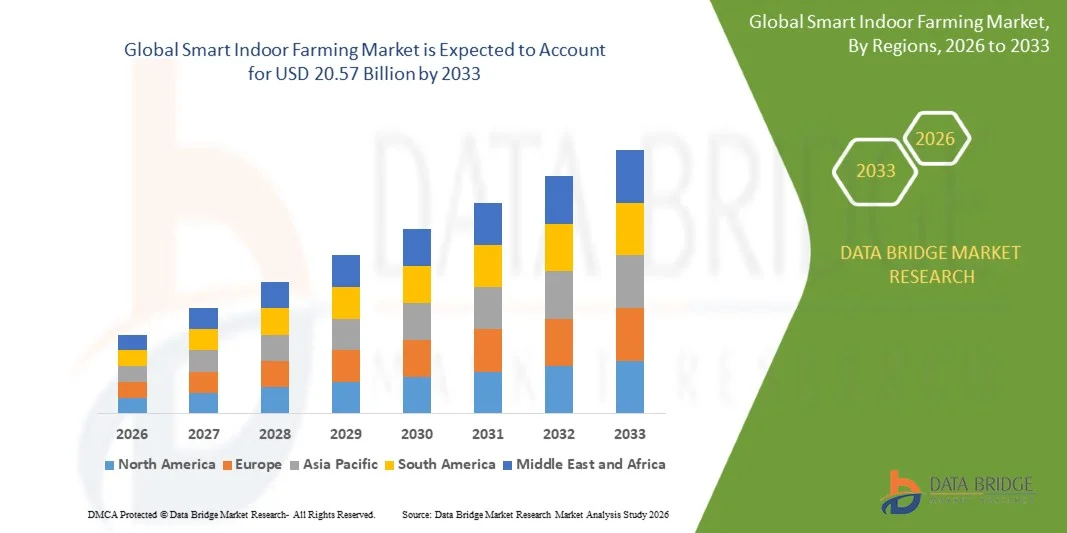
According to the latest report published by Data Bridge Market Research, the Smart Indoor Farming Market
CAGR Value
- As per Data Bridge Market Research analysis The global smart indoor farming market size was valued at USD 10.25 billion in 2025 and is expected to reach USD 20.57 billion by 2033, at a CAGR of 9.1% during the forecast period
The winning Smart Indoor Farming Market report brings into focus the new highs that will be made by the Smart Indoor Farming Market industry in the forecast period 2020 - 2027. This market report lends a hand to Smart Indoor Farming Market industry by giving actionable market insights and comprehensive market analysis. This marketing report gives explanation about the particular study of the Smart Indoor Farming Market industry with respect to market definition, market segmentation, key developments in the market, competitive analysis and research methodology with excellent tools and techniques. A team of fervent, dynamic and skilled researchers and analysts take efforts with full commitment to provide an absolute Smart Indoor Farming Market research report.
Stay informed with our latest keyword market research covering strategies, innovations, and forecasts. Download full report: https://www.databridgemarketresearch.com/reports/global-smart-indoor-farming-market
Smart Indoor Farming Market Segmentation and Market Companies
Segments
- By Component:
- Hardware
- Software
- Services
- By Type:
- Hydroponics
- Aeroponics
- Aquaponics
- By Growing System:
- Vertical Farming
- Indoor Greenhouse
- Container Farming
- By Crop Type:
- Fruits & Vegetables
- Herbs & Microgreens
- Flowers & Ornamentals
Smart indoor farming is witnessing significant growth globally across various segments. In terms of components, the market is segmented into hardware, software, and services. Hardware includes lighting systems, sensors, climate control systems, and others essential for indoor farming operations. Software solutions cater to crop monitoring, data management, and system automation. The services segment comprises consulting, maintenance, and training services to optimize smart indoor farming practices. When considering the type of farming techniques, hydroponics, aeroponics, and aquaponics are the prominent categories. Hydroponics involves growing plants in nutrient-rich water without soil, while aeroponics and aquaponics utilize mist and fish tanks, respectively, to nourish plants.
The growing system segment of the smart indoor farming market includes vertical farming, indoor greenhouse, and container farming. Vertical farming maximizes space by stacking layers of crops vertically, indoor greenhouses provide a controlled environment for year-round cultivation, and container farming utilizes repurposed containers for farming purposes. Furthermore, the market is divided based on the crop types grown indoors, such as fruits & vegetables, herbs & microgreens, and flowers & ornamentals. This segmentation allows for a targeted approach towards the specific needs of different crop varieties, ensuring optimal growth conditions and yield output within indoor farming setups.
Market Players
- Signify Holding
- Plenty Unlimited Inc.
- Aerofarms
- Illumitex Inc.
- Everlight Electronics Co., Ltd.
- Agrilution
- Heliospectra AB
- Green Sense Farms Holdings, Inc.
- Grobo
- Bowery Farming
The global smart indoor farming market is characterized by the presence of key players driving innovation and technological advancements in the sector. Companies such as Signify Holding, Plenty Unlimited Inc., and Aerofarms are at the forefront of developing cutting-edge solutions for indoor farming practices. Illumitex Inc. and Everlight Electronics Co., Ltd. specialize in providing high-quality lighting systems critical for plant growth in indoor environments. Other notable players like Agrilution, Heliospectra AB, and Green Sense Farms Holdings, Inc. offer diverse services and products to support the smart indoor farming industry. Startups like Grobo and Bowery Farming are also making significant contributions to the market through their unique approaches to sustainable agriculture and urban farming.
The smart indoor farming market is experiencing a notable shift towards sustainable and efficient agricultural practices, driven by advancements in technology and a growing emphasis on food security and environmental sustainability. One emerging trend in the market is the integration of Internet of Things (IoT) technologies and artificial intelligence (AI) to optimize crop production through data-driven decision-making processes. These technologies enable real-time monitoring of plant health, environmental conditions, and resource utilization, allowing farmers to make precise adjustments for improved yield and resource efficiency.
Another key development in the smart indoor farming market is the increasing adoption of vertical farming systems, which offer higher crop yields per square foot compared to traditional farming methods. Vertical farming not only maximizes land use but also reduces water consumption and eliminates the need for synthetic pesticides, contributing to sustainable agriculture practices. Additionally, vertical farming allows for year-round cultivation of crops, mitigating the impact of seasonal changes and external environmental factors on production.
Furthermore, the market is witnessing a rise in demand for fresh, locally grown produce, leading to the proliferation of indoor greenhouses and container farming solutions in urban areas. These compact and controlled environment setups enable farmers to cultivate a wide range of crops closer to consumers, reducing transportation costs and carbon footprint associated with long-distance food supply chains. Moreover, indoor farming offers opportunities for the cultivation of rare or exotic plant varieties that may not thrive in traditional outdoor settings, catering to niche markets and increasing product diversity.
As the smart indoor farming market continues to evolve, collaborations and partnerships between key players in the industry are becoming crucial for driving innovation and scaling operations. Companies are joining forces to leverage complementary technologies and expertise, accelerating the development of integrated solutions that address the diverse needs of indoor farming practices. By fostering a collaborative ecosystem, market players can enhance product offerings, optimize resource utilization, and expand market reach, ultimately driving the growth and maturity of the smart indoor farming industry.
In conclusion, the smart indoor farming market presents significant growth potential fueled by technological advancements, changing consumer preferences, and the need for sustainable agricultural practices. With a focus on enhancing crop productivity, resource efficiency, and environmental sustainability, market players are poised to revolutionize the future of agriculture through innovative indoor farming solutions. By staying at the forefront of technology and fostering strategic partnerships, companies can capitalize on emerging opportunities and drive the continued expansion of the smart indoor farming market globally.The smart indoor farming market is poised for substantial growth driven by the increasing adoption of advanced technologies and the rising demand for sustainable agricultural practices. Companies are focusing on developing innovative solutions to optimize crop production, enhance resource efficiency, and mitigate environmental impact. Integration of Internet of Things (IoT) and artificial intelligence (AI) technologies is a key trend in the market, enabling real-time monitoring and data-driven decision-making for improved yield and sustainability. Vertical farming systems are gaining traction for their ability to maximize land use, increase crop yields, conserve water, and reduce reliance on synthetic pesticides, contributing to eco-friendly farming practices.
Moreover, the market is witnessing a surge in the demand for fresh, locally grown produce, leading to the establishment of indoor greenhouses and container farming setups in urban areas. These controlled environment farming solutions offer the opportunity to cultivate a diverse range of crops closer to consumers, thereby reducing transportation costs and carbon emissions associated with traditional agriculture. Additionally, indoor farming enables the cultivation of rare or exotic plant varieties that may not thrive in outdoor conditions, catering to niche markets and enhancing product diversity in the market.
Collaborations and partnerships among key players in the smart indoor farming industry are becoming increasingly vital for driving innovation, scaling operations, and addressing the evolving needs of indoor farming practices. By combining their technological expertise and resources, companies can accelerate the development of integrated solutions that optimize farming efficiency and expand market reach. This collaborative approach fosters a dynamic ecosystem that promotes knowledge sharing, enhances product offerings, and fuels the growth of the smart indoor farming market on a global scale.
In conclusion, the smart indoor farming market is set to witness remarkable growth opportunities as companies continue to invest in technological advancements, sustainability initiatives, and strategic partnerships. By leveraging cutting-edge technologies, embracing sustainable farming practices, and catering to the shifting consumer preferences for locally sourced produce, market players can drive the evolution of indoor farming and revolutionize the agricultural landscape. The focus on innovation, collaboration, and sustainability will be crucial in shaping the future of smart indoor farming and unlocking its full potential for sustainable food production and environmental conservation.
Frequently Asked Questions About This Report
What is the impact of IoT on the Smart Indoor Farming Market landscape?
Which end-user segment has the highest bargaining power?
How much is the Smart Indoor Farming Market expected to grow in absolute dollar terms between 2025 and 2033?
How is the Smart Indoor Farming Market adapting to Low-Growth scenarios?
Which application segment generated the most revenue in 2025?
How are inventory management systems evolving in the Smart Indoor Farming Market?
How do regional subsidies affect Smart Indoor Farming Market adoption in Latin America?
What is the margin structure across the Smart Indoor Farming Market value chain?
Who are the key players in the Smart Indoor Farming Market for digital transformation?
How do Bundling strategies affect the Smart Indoor Farming Market CAGR?
What is the ESG rating of the top 5 Smart Indoor Farming Market players?
What are the environmental concerns related to the Smart Indoor Farming Market?
What does the value chain for the Smart Indoor Farming Market look like?
Browse More Reports:
Europe Iron-Deficiency Anemia Therapy Market
North America Iron-Deficiency Anemia Therapy Market
Asia-Pacific Maltitol in Chocolate Market
Europe Maltitol in Chocolate Market
Middle East and Africa Maltitol in Chocolate Market
North America Maltitol in Chocolate Market
U.S. Maltitol in Chocolate Market
Europe Needles Market
China Palmoplantar Pustulosis (PPP) Market
Europe Palmoplantar Pustulosis (PPP) Market
Japan Palmoplantar Pustulosis (PPP) Market
U.S. Palmoplantar Pustulosis (PPP) Market
North America Plastic Bottles and Containers Market
Asia-Pacific PolydiEthylsiloxane Based Products (PES) Market
Europe Polydiethylsiloxane Based Products (PES) Market
Contact Us:
Data Bridge Market Research
US: +1 614 591 3140
UK: +44 845 154 9652
APAC : +653 1251 980
Email:- corporatesales@databridgemarketresearch.com
Categorias
Leia mais
The global Fabric Toy Market is witnessing steady growth as consumers increasingly prefer safe, soft, eco-friendly, and personalized toys for children. Fabric toys, including stuffed animals, teddy bears, toy pillows, and figure toys, have become popular among parents due to their durability, comfort, and educational value. Rising awareness regarding sustainable products and the...

SIAPBET hadir sebagai jawaban atas kejenuhan pasar terhadap situs-situs duplikat yang monoton. SIAPBET mengukuhkan posisinya sebagai situs toto terbaik yang membawa pendekatan segar, transparan, dan berteknologi tinggi. Dengan menghadirkan layanan berkualitas, sistem keamanan yang kuat, serta pengalaman bermain yang nyaman, platform ini menjadi pilihan utama bagi para penggemar togel...
🌐 CLICK HERE 🟢==►► WATCH NOW 🔴 CLICK HERE 🌐==►► Download Now https://iyxwfree24.my.id/watch-streaming/?video=sofik-vs-sonali-video-varal-mms 1 day ago · Viral Video Of Sofik-Sonali: Once the 15-minute video spread across the internet, the Palli Gram TV creator - Sofik SK and his girlfriend took to Instagram with emotional statements, explaining that the private clip had been exposed...

elding technology continues to evolve as industries demand higher productivity, stronger joints, and efficient manufacturing. Among all welding processes, Submerged Arc Welding (SAW) stands out for its exceptional deposit rates, cleanliness, and deep penetration capabilities. At the heart of this process are Submerged Arc Welding Wires and Fluxes , which...

🌐 CLICK HERE 🟢==►► WATCH NOW🔴 CLICK HERE 🌐==►► Download Nowhttps://iyxwfree24.my.id/watch-streaming/?video=es-video-filtrado-de-isabella-ladera-y-beele-zzz-xxx-pornVideo porno Filtrado de Beéle y Isabella Ladera . Supuesto En un motel teniendo sexo sin contro. #PORNOBELE Isabella Ladera rompió el silencio tras la filtración de su video con Beéle y aseguró que...