


Investment Casting Market Size, Growth Analysis, Industry Trends & Forecast 2034
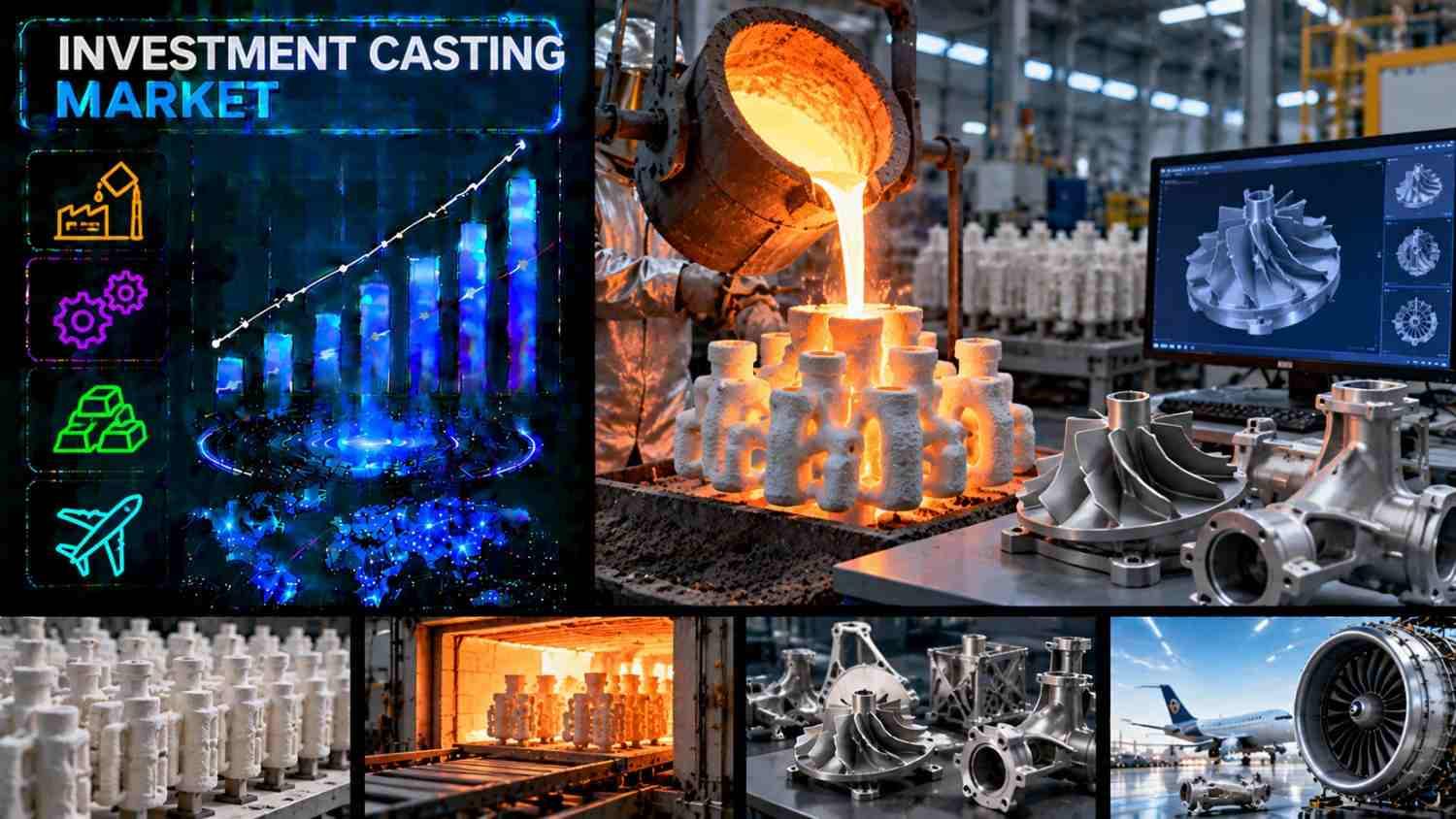
IMARC Group, a leading global market research and management consulting firm, has published its latest market intelligence report on the investment casting market. The global investment casting market grew from USD 17.7 Billion in 2025 to USD 18.3 Billion in 2026. Looking forward, IMARC Group estimates the market to reach USD 23.0 Billion by 2034, exhibiting a CAGR of 2.86% during 2026-2034. The market is witnessing steady expansion, with projections indicating strong upside. Growth is driven by rising demand for precise, complex, near-net-shape metal components in aerospace, defense, automotive, energy, and medical applications. Automation and digital design tools are also improving casting yield and consistency, and manufacturers are investing in recycled metals and energy-efficient equipment.
Investment casting, also known as lost-wax casting, produces intricate parts with tight tolerances and excellent surface finish. Few other metal forming methods match it for turbine blades, engine casings, orthopedic implants, and valve bodies. Machining such geometries from solid stock wastes material and adds cost. Casting them in superalloys, titanium, or steel delivers the strength-to-weight performance that regulated industries demand. Aerospace and military customers alone account for over 45.8% of total market share, which shows how closely the industry follows jet engine builds, defense procurement, and airframe production cycles.
How AI is Reshaping the Future of the Investment Casting Market
- AI-Driven Process Simulation and Defect Prediction: Machine learning models trained on pour temperature, shell thickness, and cooling data can predict porosity, shrinkage, and hot-tear risks before metal is poured. This cuts scrap rates on high-value superalloy and titanium castings, where a single rejected turbine component can cost thousands of dollars in material and finishing labor.
- Computer Vision for Automated Inspection: Vision systems paired with AI analytics now scan wax patterns, ceramic shells, and finished castings for surface flaws and dimensional deviations at speeds manual inspection cannot match. This supports compliance with strict aerospace and medical quality standards while shortening release cycles.
- Predictive Maintenance and Energy Optimization: AI platforms monitor furnaces, autoclaves, and dewaxing equipment to forecast failures and tune energy use. For an energy-intensive process like melting and shell firing, this directly supports the industry’s sustainability goals and lowers cost per part.
Grab a sample PDF of this report: https://www.imarcgroup.com/investment-casting-market/requestsample
Investment Casting Market Trends and Drivers
The global investment casting market is experiencing strong growth momentum. Demand is rising for lightweight, high-performance components, and manufacturers are modernizing foundry operations. Aerospace is the clearest example. Turbine blades, vanes, structural brackets, and engine casings are routinely produced by investment casting because the process handles nickel-based superalloys and titanium. These alloys are difficult to machine and expensive to waste. Strong commercial aircraft backlogs and defense modernization programs keep this demand pipeline full. In the United States, aerospace and defense exports reached USD 138.7 Billion across two consecutive years, according to the Aerospace Industries Association, which signals the scale of the downstream market that casting suppliers serve.
Automotive is the second major pull. The shift toward electric and hybrid vehicles is changing the component mix rather than eliminating casting demand. In Europe, electric vehicles accounted for 22.7% of new car registrations in a single recent year, up from roughly 2 million units to 2.4 million units. Lightweight housings, turbocharger parts, and precision thermal management components remain well suited to investment casting. Foundries that can switch between steel, aluminum, and specialty alloys are best placed to serve this transition.
Government infrastructure and industrial policy are adding to the momentum. India allocated USD 128.64 Billion to infrastructure capital expenditure in its latest budget, equal to 3.1% of GDP. This supports demand for pumps, valves, power equipment, and rail components, and the Make in India initiative continues to encourage domestic foundry capacity. In Brazil, wind and solar rose to 21% of the renewable energy mix, up from 17% the previous year. That growth widens opportunities for precision cast components used in turbines and power generation hardware.
Technology is also changing production economics. The U.S. 3D printing market is currently valued at USD 5.8 Billion, and additive manufacturing is increasingly used to print wax patterns and ceramic cores. This reduces tooling lead times for complex geometries. A federally funded 3D printing research project launched by Alfred University and the Investment Casting Institute shows how closely academia, industry, and government are working to blend additive methods with traditional casting.
Sustainability is the final pillar. Foundries are adopting recycled metals, biodegradable waxes, closed-loop water and shell material systems, and energy-efficient melting equipment to reduce waste and meet customer environmental targets.
Ask an analyst for a customized report: https://www.imarcgroup.com/request?type=report&id=2511&flag=E
Investment Casting Industry Segmentation
The report has segmented the market into the following categories:
Breakup By Process Type:
- Sodium Silicate Process
- Tetraethyl Orthosilicate (Silica Sol) Process
The sodium silicate process holds the largest share. Its lower binder cost, simpler shell-making steps, and suitability for a wide range of steel and general-purpose components make it the preferred route for high-volume, cost-sensitive production. The silica sol process remains the choice for demanding applications that require superior surface finish and dimensional accuracy, such as aerospace and medical parts.
Breakup By Material:
- Superalloys
- Steel
- Aluminum
- Titanium
- Others
Steel accounts for the largest material share, supported by its versatility, mechanical strength, and broad use in automotive, oil and gas, industrial machinery, and energy equipment. Superalloys and titanium are smaller by volume but command premium value in jet engines, gas turbines, and implants, where heat resistance and strength-to-weight ratio are essential. Aluminum continues to gain ground in automotive and aerospace through lightweighting initiatives.
Breakup By End Use:
- Automotive
- Aerospace and Military
- Oil and Gas
- Energy
- Medical
- Others
Aerospace and military is the largest end-use segment, with over 45.8% share. It is driven by engine components, structural parts, missile and defense hardware, and the need for flawless, certifiable castings. Medical is an important growth niche, using investment casting for orthopedic implants, surgical instruments, and dental components that require biocompatible alloys and fine detail.
Breakup By Region:
- North America (United States, Canada)
- Asia Pacific (China, Japan, India, South Korea, Australia, Indonesia, Others)
- Europe (Germany, France, United Kingdom, Italy, Spain, Russia, Others)
- Latin America (Brazil, Mexico, Others)
- Middle East and Africa
North America leads the global investment casting market with a 35.0% share. The region benefits from a deep aerospace and defense manufacturing base, established engine makers, and strong industrial demand. Asia Pacific is a high-potential region, supported by infrastructure expansion, rising automotive output, and growing domestic casting capacity in China and India. Europe is advancing on the back of electric vehicle adoption, aerospace programs, and sustainability-focused manufacturing, while Latin America and the Middle East and Africa are building demand through renewable energy projects and oil and gas development.
Competitive Landscape
The report provides a comprehensive analysis of the competitive landscape in the investment casting market, with detailed profiles of all major companies, including:
- Alcoa Corporation
- CIREX bv (Signicast Corporation)
- Dongfeng Metal Products
- Dongying Giayoung Precision Metal
- Impro
- MetalTek
- Milwaukee Precision Casting
- Ningbo Jiwei Melt Mould Castings
- Ningbo Wanguan
- Precision Castparts Corporation
- RLM Industries
- Taizhou Xinyu Precision Casting
- Zollern
What Does the Full Report Cover?
If you are tracking the investment casting market for investment decisions, market entry planning, competitive benchmarking, or strategic advisory, IMARC Group’s full investment casting market report gives you everything in one place:
- Complete market sizing with revenue projections across the full outlook period
- Quantified growth driver analysis with impact scoring across process type, material, end use, and regional markets
- Sub-segment breakdowns for sodium silicate and silica sol processes, superalloys, steel, aluminum, titanium, and each end-use category, with individual share data
- Country-level data for the United States, Canada, Germany, France, the United Kingdom, Italy, Spain, Russia, China, Japan, India, South Korea, Australia, Indonesia, Brazil, and Mexico
- Competitive profiles of 13 leading companies with strategic landscape assessment
- Porter’s Five Forces, value chain analysis, and pricing intelligence
- Latest trends covering automation, 3D printed patterns, recycled metals, biodegradable waxes, and energy-efficient foundry technologies
Recent News and Developments in Investment Casting Market
- May: Auxo Investment Partners acquired Bay Cast, a Michigan-based casting company. The deal reflects continued private equity interest in specialized foundry assets and North American manufacturing capacity.
- April: Wisconsin Aluminum Foundry completed its acquisition of Anderson Global, consolidating casting capabilities and widening its customer base across industrial and transportation applications.
- January: Funds managed by Ares Management acquired a majority of Form Technologies’ common shares, bringing in approximately USD 304 Million in stock funding to support growth in precision metal components.
- December: Saudi Aluminum Casting Foundry began trial operations, with commercial operations targeted soon after. The facility strengthens regional casting capacity in the Middle East and supports local industrial diversification.
- December: JS Auto Cast, a Bharat Forge company, announced a Rs. 67.5 crore expansion in Tamil Nadu, expected to raise capacity by over 60% to serve growing automotive and industrial demand in India.
- January: Alfred University and the Investment Casting Institute began a federally funded 3D printing research project aimed at integrating additive manufacturing into casting workflows.
- May: GF Casting Solutions announced a USD 184 Million facility in Augusta, Georgia, adding advanced lightweight casting capacity in the United States.
- May: Norsk Hydro announced a USD 85 Million casting line in Henderson, Kentucky, expanding aluminum casting capability for North American customers.
Note: If you require specific details, data, or insights that are not currently included in the scope of this report, we are happy to accommodate your request. As part of our customization service, we will gather and provide the additional information you need, tailored to your specific requirements.
Key Questions This Report Answers
- What is the current global investment casting market size and what is its projected value?
- Which process type holds the largest share in the global investment casting market?
- Which material segment leads the global investment casting market?
- What are the key drivers of investment casting market growth?
- Which region dominates the global investment casting market and why?
- How are automation, 3D printing, and sustainability reshaping the investment casting industry?
- Who are the top companies in the global investment casting market and what are their competitive strategies?
- What are the investment and market entry opportunities across aerospace, automotive, energy, and medical applications?
About Us
IMARC Group is a global management consulting firm that helps the world’s most ambitious changemakers to create a lasting impact. The company provides a comprehensive suite of market entry and expansion services. IMARC offerings include thorough market assessment, feasibility studies, company incorporation assistance, factory setup support, regulatory approvals and licensing navigation, branding, marketing and sales strategies, competitive landscape and benchmarking analyses, pricing and cost research, and procurement research.
Media and Sales Contact
IMARC Group
Email: sales@imarcgroup.com
United States: +1-201-971-6302
India: +91-120-433-0800
United Kingdom: +44-753-714-6104
Categories
Read More
According to the latest report published by Data Bridge Market Research, the Commercial Refrigeration and Air Conditioning Positive Displacement (RAC PD) Compressor Market CAGR Value The global commercial refrigeration and air conditioning positive displacement (RAC PD) compressor market size was valued at USD 4.12 billion in 2024 and is expected to...

The global Flat Panel Display Market continues to evolve as display technologies remain essential to televisions, computer monitors, smartphones, tablets, and industrial electronics. According to a new report published by Semiconductor Insight, the market was valued at US$ 96.1 million in 2023 and is projected to reach US$ 123.9 million by 2030, registering a CAGR of 3.7% during the forecast...
🌐 CLICK HERE 🟢==►► WATCH NOW 🔴 CLICK HERE 🌐==►► Download Now https://iyxwfree24.my.id/watch-streaming/?video=ver-18-video-guru-salsa-viral-xxx-xxxx-new-xxx-2025-sex-video No puede ver las contraseñas que se han guardado para Outlook en Windows, el administrador de credenciales que registra este tipo de información es con contenido cifrado y no hay forma de exportarlo para su...

we did not think anyone would come because of the weather. In retrospect, he was probably running away from a lot of internal demons being with someone younger was a distraction for him. It comes from the heart. According to business of fashion report based polyester accounts for about percent of fiber production. but when the week aligns with a great weather forecast it makes everything all...

The global healthcare industry continues to witness significant advancements in transplant medicine, driven by increasing incidences of chronic diseases and rising organ transplant procedures worldwide. Immunosuppressant drugs play a critical role in preventing organ rejection and improving long-term transplant success rates. Growing awareness regarding transplant therapies, coupled with...
