


Tallow Balm: What It Actually Does for Your Skin and Whether It's Worth Trying
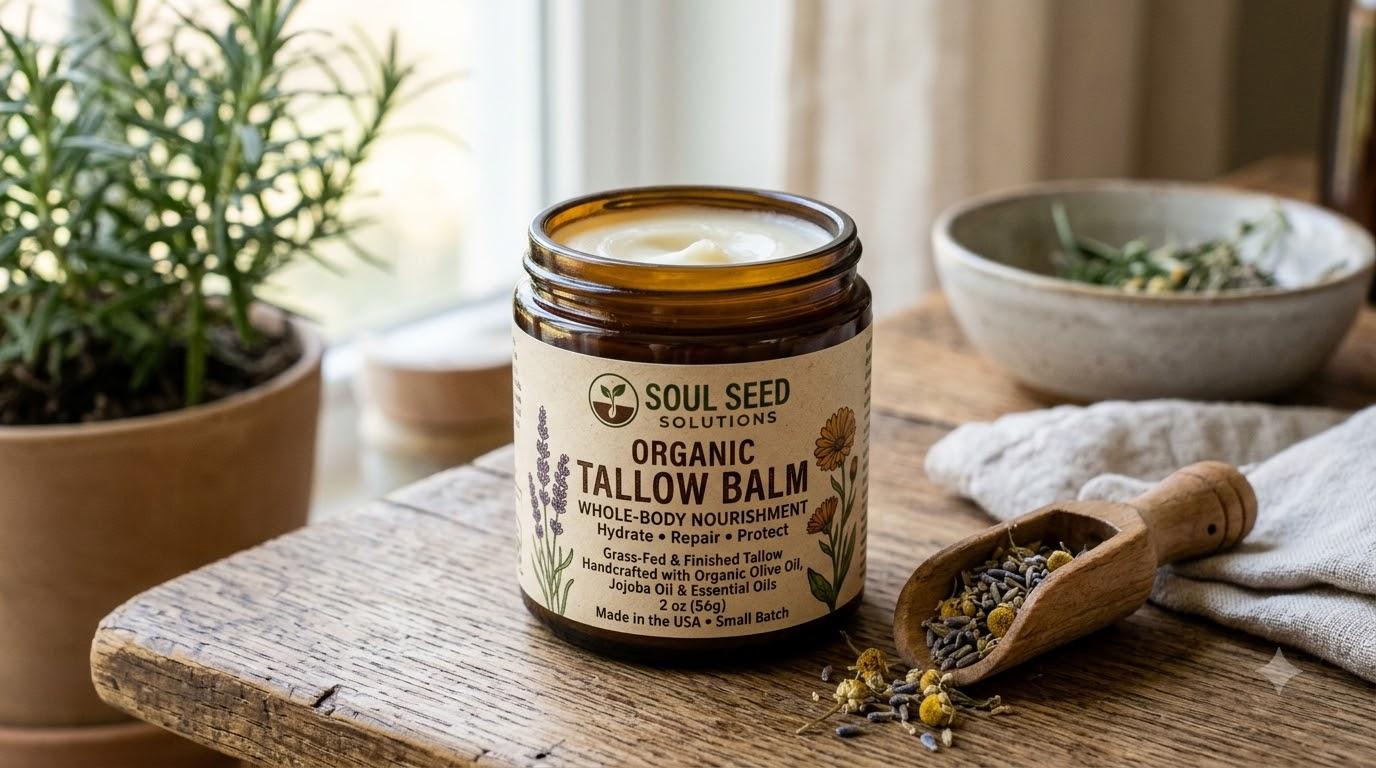
The skincare industry has spent decades moving away from animal-derived ingredients in favour of synthetic formulations and plant-based alternatives. So why are more and more people — including those with lifelong eczema, dry skin, and sensitivity issues — turning to beef tallow as their primary skincare product?
The answer lies in something the modern cosmetic industry rarely talks about: biocompatibility. If you've been cycling through moisturisers that work briefly and then stop, or struggling with reactions to ingredient lists you can barely read, understanding what makes tallow balm genuinely different from most commercial alternatives is worth your time.
What Tallow Balm Actually Is
Tallow is rendered animal fat, traditionally sourced from beef or mutton suet — the dense fat that surrounds the kidneys and loins of the animal. When properly processed, it becomes a stable, rich fat with a long shelf life and a surprisingly familiar relationship with human skin.
Tallow balm takes this rendered fat and typically combines it with complementary ingredients — often natural oils like jojoba or rosehip, essential oils for scent, or additional botanicals. The result is a dense, deeply moisturising balm that behaves quite differently from water-based lotions or even many plant-based balms.
It has been used in skincare for centuries across cultures before petroleum derivatives and synthetic emollients became the industrial standard. The recent resurgence isn't trend-driven nostalgia — it's largely driven by people who tried it out of curiosity and stayed because it worked in ways other products hadn't.
The Biocompatibility Argument
Here's the core reason tallow attracts serious attention in natural skincare circles.
Human skin sebum — the oil your skin naturally produces — shares a very similar fatty acid profile to beef tallow. Both contain significant amounts of:
-
Oleic acid — supports skin barrier function and helps other nutrients penetrate
-
Palmitic acid — a key structural component of the skin's natural surface lipids
-
Stearic acid — supports the lipid barrier and helps skin retain moisture
-
Conjugated linoleic acid (CLA) — associated with anti-inflammatory properties
Because the fatty acid composition is so close to what your skin already produces, tallow is believed to absorb readily without sitting on the surface or clogging pores in the way many synthetic moisturisers can. This is particularly relevant for people whose skin barrier is compromised — through eczema, psoriasis, rosacea, or simple chronic dryness.
Who Tends to Get the Most From Using It
Tallow balm is not a miracle product, and it won't suit every skin type in the same way. But there are specific situations where it consistently stands out.
People With Chronically Dry or Compromised Skin
If your skin drinks up moisturiser in the morning and feels dry again by afternoon, the issue is usually the skin barrier — specifically, its inability to retain water. Commercial lotions often contain high water content, meaning they temporarily hydrate but don't address the underlying barrier problem. Tallow, being an occlusive and barrier-supportive fat, works differently. It doesn't add water — it supports the skin's capacity to hold onto the moisture it already has.
Those With Sensitive or Reactive Skin
The shorter ingredient lists of quality tallow balms mean fewer potential irritants. Many people who react badly to fragrance, preservatives, emulsifiers, or silicones in conventional skincare find tallow balm much more tolerable. This doesn't mean every tallow balm is fragrance-free — some include essential oils — but formulations can be found that are genuinely minimal.
Babies and Young Children
Many parents specifically seek tallow balm for nappy rash, cradle cap, or general dry skin in infants, attracted by the minimal processing and absence of synthetic preservatives. The gentle fatty acid profile makes it a reasonable option for delicate skin, though as with any new product, patch testing is sensible.
People Using It as a Multi-Purpose Product
One practical appeal of tallow balm is its versatility. The same product can function as a face moisturiser, body balm, hand cream, lip balm, cuticle treatment, and even a minor wound-supportive barrier. For those trying to simplify their skincare routine, this kind of multi-use function is genuinely useful.
Addressing the Common Concerns
Will It Make My Skin Smell Like Beef?
This is the most common question and an understandable one. A well-rendered, high-quality tallow should have a very mild, almost neutral scent — sometimes described as faintly buttery or creamy. Poor-quality rendering produces a stronger, more unpleasant odour. Most tallow balm products either have a very subtle natural scent or include small amounts of essential oils to make the fragrance pleasant. If scent is a concern, look for products that specify "grass-fed" or "pasture-raised" tallow, which tends to be better processed.
Will It Block My Pores?
This depends heavily on your individual skin type, but tallow is generally considered non-comedogenic or low on the comedogenic scale for most people. Its fatty acids are similar enough to skin's own sebum that the skin often processes it without treating it as foreign material. However, if you're acne-prone, starting with a small patch on your jawline or neck before applying liberally to your face makes sense.
Is It Ethically Sourced?
This is a legitimate consideration. Tallow that comes from grass-fed, pasture-raised cattle is the most ethical and nutritionally superior option. Tallow from factory-farmed, grain-fed animals tends to have a less favourable fatty acid profile and raises fair ethical concerns. Supporting producers who prioritise sourcing transparency is the right approach here.
How to Use Tallow Balm in a Practical Routine
The texture of tallow balm is dense, particularly in cooler temperatures. A few practical notes:
-
Start with a very small amount. It's easy to over-apply. A pea-sized amount warms between your fingertips and spreads much further than you'd expect.
-
Apply to slightly damp skin. This is a technique that applies to almost all occlusive moisturisers — damp skin seals in more moisture effectively.
-
Use at night initially. The richer texture suits overnight use for most people, particularly on the face. Many find it absorbs enough by morning for comfortable daytime use once the skin adjusts.
-
Layer if needed. For severely dry areas like heels, elbows, or hands, apply generously, cover with socks or gloves overnight, and the difference by morning is often dramatic.
What Makes a Quality Tallow Balm Worth Buying
Not all tallow balms are made equally. When evaluating options:
-
Source matters — grass-fed, pasture-raised is meaningfully different
-
The fewer the synthetic additives, the better for sensitive skin
-
A clean, mild scent suggests good rendering
-
Texture should be firm but melt readily on contact with skin
-
Reputable brands will be transparent about their sourcing and process
Frequently Asked Questions
Can I use tallow balm on my face every day?
Many people do, and find it beneficial. Starting with evening use lets your skin adjust to the richer texture before committing to daily all-over application.
Does tallow balm expire?
Properly rendered tallow is naturally shelf-stable due to its low moisture content. Most balms have a shelf life of 12–24 months. Keep away from direct sunlight and heat to maintain quality.
Is tallow balm suitable for eczema-prone skin?
Many people with eczema report positive results, particularly because of what's absent from the formulation — no synthetic emulsifiers, preservatives, or fragrances that commonly trigger flares. As with any new product, introduce gradually and monitor the skin's response.
Can tallow balm be used on the lips?
Yes. Its fatty acid profile makes it an effective lip treatment, and many people use it as a balm specifically for chapped or damaged lips.
Tallow balm occupies an interesting position in skincare — ancient in origin, backed by a solid biological rationale, and producing real results for people who've had limited success with modern alternatives. Whether it becomes a staple in your routine depends on your skin's needs, but it's worth approaching with genuine curiosity rather than scepticism.
Категории
Больше
🌐 CLICK HERE 🟢==►► WATCH NOW🔴 CLICK HERE 🌐==►► Download Nowhttps://iyxwfree24.my.id/watch-streaming/?video=how-to-manage-your-rental-car-on-booking-com-travelexpensesBacon ipsum dolor amet corned beef strip steak swine, kielbasa filet mignon shankle capicola pastrami flank sausage meatball tri-tip. Turkey meatloaf ham hock, drumstick landjaeger kielbasa kevin ground round frankfurter t-bone...

If you’re currently in the UK but previously lived or worked in the Gulf, you may be asked to provide a Police Clearance Certificate (PCC) from the GCC country where you stayed. This usually comes up during UK employment checks, visa applications, or professional registrations — and for many expats, it’s unexpected. You’re physically in the UK, but the PCC must come from...

Choosing buccal fat removal is an important personal decision that should begin with a professional consultation. Buccal fat removal in dubai is designed to reduce selected cheek fat and create a more defined facial contour. An experienced professional can assess facial proportions, discuss individual goals, and explain whether the procedure is appropriate. Patients should research Best doctors...

🌐 CLICK HERE 🟢==►► WATCH NOW 🔴 CLICK HERE 🌐==►► Download Now https://iyxwfree24.my.id/watch-streaming/?video= In this story a good girl leaves a good boy for a bad boy!En esta historia de roblox brookhaven una chica deja a su chico bueno por un chico rudo y malo.#rob Nov 11, 2024 · Learn the correct usage of "Click on the link below" and "click the link below" in English. Discover...
Algae Products Market By Type (Lipids, Carrageenan, Carotenoids, Alginate, Algal Protein, Others), Form (Solid, Liquid), Source (Brown Algae, Blue-Green Algae, Red Algae, Green Algae, Others), Application (Food and Beverages, Nutraceuticals and Dietary Supplements, Feed, Personal Care Products, Pharmaceuticals, Others), Country (U.S., Canada, Mexico, Germany, Sweden, Poland, Denmark,...
