

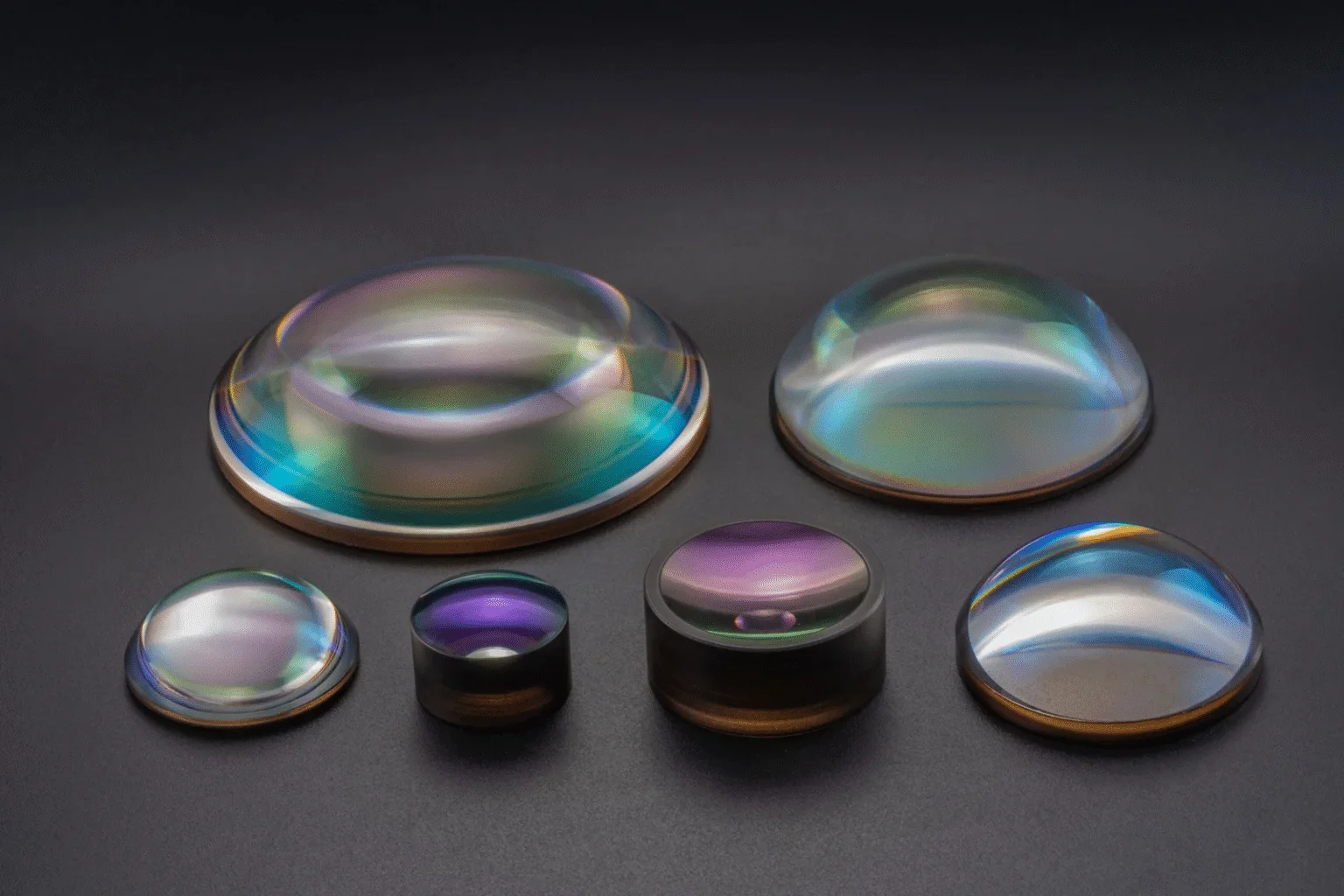

Precision optics are essential in many modern technologies, from imaging equipment and scientific instruments to industrial inspection systems. The quality and design of individual optical components can influence how light travels through a system and how clearly an image is formed. A glass spherical lens is a widely used optical component that refracts light through curved surfaces to converge or diverge light rays according to its design.
What Is a Glass Spherical Lens?
A glass spherical lens is an optical component made from glass with one or more surfaces shaped as portions of a sphere. These curved surfaces change the direction of light as it passes through the lens, allowing the component to focus light, spread it out, or help form an image.
Spherical lenses are commonly classified as convex or concave. A convex lens is generally thicker in the center than at the edges and can converge parallel light rays under typical operating conditions. A concave lens is generally thinner in the center and can cause parallel light rays to diverge.
The exact optical behavior depends on the lens curvature, refractive index, thickness, surrounding medium, and the position of the light source or object. These characteristics determine how the lens performs within a particular optical assembly.
How Does a Glass Spherical Lens Work?
A spherical lens works through refraction, which occurs when light changes direction as it passes between materials with different refractive indices. When light enters and exits a glass lens, its curved surfaces alter the path of the rays.
In a converging lens, parallel rays can be brought toward a focal point. This property is useful in systems that need to collect light or form an image. In a diverging lens, parallel rays spread apart after passing through the lens, creating a different optical effect.
The focal length describes the lens's focusing behavior under specified optical conditions. A shorter focal length generally indicates stronger optical power, while a longer focal length indicates weaker optical power. The actual focal length depends on the lens geometry and refractive index.
Lens design also involves controlling optical aberrations. Spherical surfaces can introduce spherical aberration, where rays passing through different parts of the lens do not converge at exactly the same point. The impact depends on the lens design and application requirements.
Key Advantages of Glass Spherical Lenses
Glass spherical lenses are used in many optical systems because they offer useful optical and manufacturing characteristics.
Optical transmission: Suitable optical glass can transmit light effectively across its intended wavelength range. Actual transmission depends on the glass composition, wavelength, surface condition, and any applied coatings.
Design flexibility: Different curvatures, diameters, thicknesses, and glass materials allow spherical lenses to serve a variety of optical functions.
Surface durability: Many optical glasses provide good surface hardness and resistance to routine handling, although performance varies by material and environmental exposure.
Precision manufacturing: Spherical surfaces can be manufactured and inspected using established optical production techniques, supporting applications with defined dimensional and surface-quality requirements.
Broad application potential: Depending on their specifications, these lenses can be incorporated into imaging systems, measurement equipment, illumination assemblies, and other optical devices.
Choosing the right glass and geometry remains essential because not every spherical lens suits every application.
Common Applications of Glass Spherical Lenses
Glass spherical lenses are found across several industries where light control and image formation are important.
Imaging equipment: Cameras and other imaging systems use lenses to collect and focus light for image formation.
Scientific instruments: Laboratory and measurement equipment may incorporate spherical lenses to direct light through an optical path or focus it onto a detector.
Industrial inspection: Optical inspection systems can use lenses to capture images of components, surfaces, and manufactured products.
Laser and photonics systems: Depending on the design and wavelength, spherical lenses can help focus or collimate light in optical assemblies.
Medical and analytical equipment: Certain diagnostic and analytical instruments use spherical lenses as part of their imaging or light-delivery systems.
The required focal length, aperture, optical material, and surface quality vary according to the application.
How to Choose the Right Glass Spherical Lens
Selecting a suitable lens begins with defining the required optical function. Determine whether the system needs to focus light, produce an image, diverge a beam, or perform another optical task.
Next, consider focal length, diameter, thickness, curvature, and refractive index. These specifications influence how the lens behaves and whether it will fit the intended optical design.
The operating wavelength is also important. Different glass materials have different transmission and dispersion characteristics, so material selection should match the system's spectral requirements.
For precision applications, review surface quality, dimensional tolerances, centration, and coating options. Mechanical compatibility and environmental conditions should also be considered before procurement.
Consulting technical documentation and testing a lens within the intended assembly can help verify compatibility and identify performance limitations before full-scale production.
Explore Glass Spherical Lens Solutions with ARV Optical
Choosing optical components requires careful attention to geometry, material properties, and application-specific performance. A well-specified lens can help engineers build optical systems that meet their intended imaging or light-control requirements.
ARV Optical provides information about glass spherical lens technology and its working principles. Businesses and engineers researching a glass spherical lens can explore the product-related information and evaluate the relevant optical characteristics for their projects.
By comparing specifications and confirming compatibility with the wider optical assembly, buyers can make informed decisions when sourcing spherical lenses for precision applications.


