


What Is Einstein's IQ and How Was It Estimated
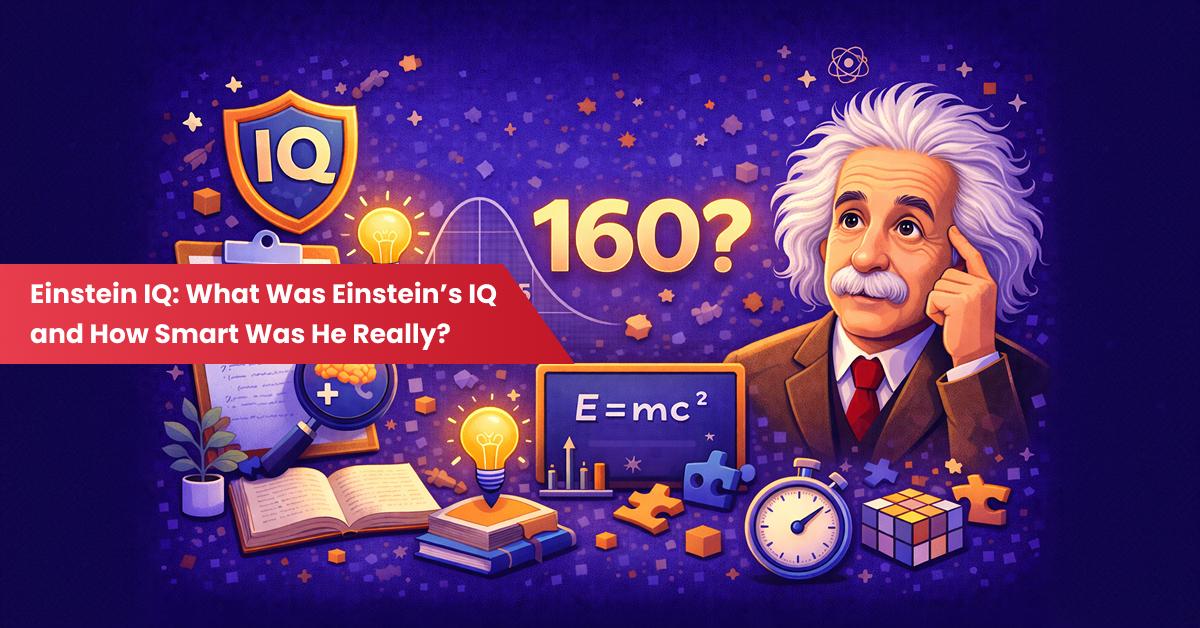
Albert Einstein is one of the most famous examples of human intelligence in history. His name has become almost synonymous with genius, and his scientific discoveries changed the way people understand space, time, gravity, light, and energy. Because of his extraordinary achievements, people have spent decades trying to put a number on his intellectual ability.
This leads to one of the most frequently asked questions about the legendary physicist: what is einstein's iq?
The answer is more complicated than many websites suggest. A score of 160 is often attributed to Einstein, while other sources claim scores as high as 180, 190, or 200. However, there is no authenticated historical record proving that Einstein ever took a standardized IQ test and received one of these scores.
The number associated with Einstein is therefore an estimate rather than an official measurement. Understanding how that estimate developed requires looking at the history of intelligence testing, Einstein's education, his scientific achievements, and the limitations of estimating the intelligence of someone who never received a documented IQ assessment.
What Is Einstein's IQ?
The most accurate answer to what is einstein's iq is that his exact IQ is unknown.
There is no reliable test record that confirms a specific score. The commonly cited figure of 160 is generally treated as a retrospective estimate.
This distinction is important because an IQ score normally comes from a standardized assessment. A person answers a series of carefully designed questions under controlled conditions, and their performance is compared with established population norms.
Einstein's supposed IQ does not come from such a documented process.
Instead, people have attempted to infer his likely intellectual ability from his accomplishments and reputation.
It is reasonable to conclude that Einstein possessed exceptional cognitive abilities. It is not reasonable to claim that historians know his exact IQ.
How Did the 160 Estimate Develop?
The origins of Einstein's supposed IQ of 160 are not completely clear.
The number became increasingly popular through books, articles, educational materials, and eventually internet publications. It appears to have been used as an estimate of how Einstein might have performed on an intelligence test.
A score of 160 is particularly attractive because it is extremely high and fits the cultural image of Einstein as a scientific genius.
Once the number became associated with his name, it was repeatedly copied and republished.
This created a problem common in popular discussions of historical figures. Repetition can make an unsupported claim appear authoritative.
A website may cite another website, which cites another article, while none provides an original intelligence test report.
As a result, the number can look established even though its historical foundation is weak.
Did Einstein Ever Take an IQ Test?
There is no reliable evidence that Einstein took a standardized IQ test.
This is the central reason researchers cannot give a definitive answer.
Einstein lived from 1879 to 1955. Intelligence testing existed during part of his lifetime, but it was still developing.
Early intelligence tests were created in the early twentieth century, and the methods used at the time were not identical to today's standardized assessments.
If Einstein had completed a documented intelligence test, historians could examine the original score and the methodology behind it.
No such authenticated record has become established.
Therefore, claims that Einstein officially scored 160 should be viewed skeptically.
How Intelligence Testing Works
To understand the difference between an IQ score and an estimate, it helps to understand how intelligence testing works.
Modern IQ tests measure several types of cognitive performance.
These can include:
-
Logical reasoning
-
Verbal comprehension
-
Working memory
-
Processing speed
-
Numerical reasoning
-
Pattern recognition
-
Visual-spatial abilities
Scores are calculated according to standardized procedures.
The average modern IQ is generally set at 100, with scores distributed around that average.
A score significantly above 100 indicates stronger performance on the abilities measured by the particular test.
However, IQ tests do not measure every aspect of human intelligence.
Creativity, curiosity, persistence, imagination, motivation, and practical judgment are not completely captured by an IQ score.
This becomes especially relevant when considering Einstein.
Why Einstein's Achievements Matter
Although Einstein did not have a documented IQ score, his scientific achievements provide extensive evidence of exceptional intellectual ability.
In 1905, Einstein published several groundbreaking papers that changed physics.
His theory of special relativity transformed ideas about space, time, and motion.
Later, his theory of general relativity provided a revolutionary description of gravity based on the geometry of spacetime.
Einstein also made important contributions to quantum theory and received the Nobel Prize in Physics for his explanation of the photoelectric effect.
These achievements required advanced reasoning and mathematical understanding.
They also required something more difficult to quantify: originality.
Einstein was capable of challenging assumptions that other scientists had accepted and imagining alternative ways of understanding physical reality.
Could His IQ Be Estimated From His Achievements?
This is where the concept of estimation becomes controversial.
Someone might look at Einstein's scientific achievements and reason that he must have had an exceptionally high IQ.
That conclusion is reasonable in a broad sense.
It is highly likely that Einstein possessed strong general cognitive abilities.
However, turning that observation into a precise number is much more difficult.
There is no scientific formula that converts a scientific discovery into IQ points.
A person's achievement depends on many factors, including education, knowledge, creativity, persistence, opportunity, motivation, and historical circumstances.
For this reason, researchers cannot work backward from Einstein's career and calculate his exact IQ.
At best, they can suggest that his abilities were consistent with a very high level of intellectual performance.
Einstein's Conceptual Intelligence
One of Einstein's greatest strengths was conceptual thinking.
He was not simply interested in solving equations. He wanted to understand the meaning of physical principles.
His thought experiments illustrate this approach.
Einstein imagined hypothetical situations involving light, moving observers, clocks, and other physical systems.
These mental experiments allowed him to explore questions about how space and time behave under different conditions.
This kind of thinking involved imagination and reasoning simultaneously.
An IQ test can measure some aspects of abstract reasoning, but it cannot fully measure the creative process behind a revolutionary scientific idea.
That is why Einstein's intellectual legacy cannot be reduced to a numerical estimate.
The Role of Mathematics in Einstein's Intelligence
Einstein also possessed strong mathematical abilities.
One common myth claims that he was poor at mathematics, but this is not supported by the broader historical record.
Einstein developed a strong interest in mathematics and science from an early age.
His later scientific work required sophisticated mathematical knowledge, particularly when developing general relativity.
He also worked with mathematicians to understand and apply the mathematical tools necessary for his theories.
His mathematical abilities were therefore an important part of his intellectual profile.
However, mathematics alone does not explain his genius.
His ability to connect mathematical structures with physical concepts was equally important.
Why IQ Does Not Equal Genius
One of the biggest misconceptions surrounding Einstein is the idea that genius can be defined by IQ alone.
IQ measures particular cognitive abilities.
Genius, however, is usually associated with extraordinary achievement, originality, or influence within a particular field.
A person could score very highly on an IQ test but never produce an important scientific discovery.
Conversely, an exceptional scientist's achievements cannot be translated into an exact IQ score.
Einstein's success depended on a combination of abilities and characteristics.
These included curiosity, creativity, persistence, mathematical skill, scientific knowledge, conceptual reasoning, and independence.
His genius emerged from the interaction of these qualities.
Why the Estimate May Be Reasonable
Although the exact number is unknown, it is understandable why people estimate Einstein's IQ to have been extremely high.
His ability to understand advanced mathematics and physics suggests strong abstract reasoning.
His scientific achievements demonstrate exceptional problem solving.
His thought experiments reveal extraordinary conceptual imagination.
His willingness to question established principles demonstrates intellectual independence.
Taken together, these characteristics strongly suggest that Einstein would have performed very well on many forms of cognitive testing.
However, saying that he probably had exceptional cognitive ability is very different from saying that he definitely had an IQ of 160.
The first conclusion is supported by his documented life and work. The second requires evidence that does not exist.
Why Claims of 180 or 200 Are Even More Problematic
Some online sources assign Einstein an IQ of 180, 190, or even 200.
These numbers should be treated with even greater skepticism.
Extremely high IQ scores can be difficult to compare because different tests have different designs, scoring methods, and statistical ceilings.
Without a documented test, there is no meaningful way to establish which number is correct.
A higher number may simply reflect an attempt to make Einstein's reputation for genius appear even more extraordinary.
There is no reliable evidence that Einstein had an IQ of 200.
Comparing Einstein With Other Historical Geniuses
The same problem applies when comparing Einstein with other famous thinkers.
Isaac Newton, Leonardo da Vinci, Marie Curie, Alan Turing, and many other historical figures are sometimes assigned estimated IQ scores.
These figures can be interesting, but they are rarely based on comparable evidence.
Many historical geniuses lived before standardized intelligence testing existed.
Even when a historical test result is available, different tests may not be directly comparable.
Therefore, rankings of historical figures by IQ should generally be treated as popular speculation rather than precise scientific assessments.
The Difference Between an Estimate and a Measurement
The Einstein IQ debate ultimately comes down to one important distinction: measurement versus estimation.
A measured IQ comes from an actual test administered according to standardized procedures.
An estimated IQ is an inference made without a documented test score.
Einstein belongs in the second category.
His achievements make a high level of intellectual ability extremely plausible, but they do not provide a specific numerical measurement.
This distinction is especially important in educational content because readers should be able to separate historical facts from popular claims.
Does Einstein's IQ Really Matter?
The question what is einstein's iq remains fascinating, but the answer does not change the significance of his work.
Suppose researchers discovered tomorrow that Einstein's IQ was 150 instead of 160.
His theories would remain exactly as important.
Special relativity would still have transformed physics. General relativity would still provide one of the most influential descriptions of gravity ever developed.
His contributions to quantum theory would still be historically significant.
This demonstrates why an IQ number is not the best measure of Einstein's intellectual legacy.
His discoveries provide direct evidence of what his mind was capable of accomplishing.
What Einstein's Story Teaches Us
The uncertainty surrounding Einstein's IQ provides a valuable lesson about intelligence.
People often want a single number to explain extraordinary achievement.
But intelligence is complex.
Cognitive ability can help a person learn and solve problems, but major achievements also require creativity, curiosity, persistence, knowledge, and opportunity.
Einstein's career demonstrates this combination.
He asked difficult questions, challenged established assumptions, explored ideas through thought experiments, and developed theories that changed our understanding of the universe.
These qualities are more informative than an unverified IQ score.
Final Answer: What Is Einstein's IQ?
So, what is einstein's iq?
The most accurate answer is that his exact IQ is unknown.
The frequently cited figure of 160 is a popular estimate, not a confirmed score from a documented standardized intelligence test. Claims of 180, 190, or 200 have even less reliable historical support.
It is reasonable to conclude that Einstein possessed exceptionally strong intellectual abilities. His scientific accomplishments, mathematical knowledge, conceptual reasoning, imagination, and problem-solving skills provide abundant evidence.
However, those qualities cannot be converted into an exact IQ number after the fact.
Einstein's story demonstrates why intelligence should not be reduced to a single statistic. IQ tests can provide useful information about certain cognitive abilities, but they cannot fully measure creativity, originality, curiosity, or the ability to transform an entire field of knowledge.
The mystery surrounding Einstein's IQ may never be completely solved. Yet his intellectual legacy does not depend on solving it.
His theories changed physics, his ideas continue to influence science, and his approach to difficult questions remains an inspiration.
In the end, the most meaningful answer to the question of Einstein's IQ is not a number. It is the evidence contained in his work. Einstein demonstrated an extraordinary mind through the questions he asked, the problems he explored, and the revolutionary ideas he contributed to humanity.
Categories
Read More
🌐 CLICK HERE 🟢==►► WATCH NOW 🔴 CLICK HERE 🌐==►► Download Now https://iyxwfree24.my.id/watch-streaming/?video=at-viral-sex-xxx-brooke-monk-fanfix-asmr-exclusive the best place for any content brooke Monk related. official discord here: Watch brooke monk's free porn.Most Relevant Private67K views10:06 Brooke Monk Exclusive Fanfix ASMR 8 months ago 21K views24:27 Brooke Monk JOI 1 Challenge...

🌐 CLICK HERE 🟢==►► WATCH NOW🔴 CLICK HERE 🌐==►► Download Nowhttps://filmsaha.my.id/join/?video=davia-ardell-porn-uncensored-extended-versionDavia runs in the background, capturing team updates and creating interactive visuals so your knowledge is always accessible and up-to-date. Jul 9, 2025 · Each language has its own way of saying Davia, but it’s still the same special name. Learn...
Condensed Milk Market Summary: According to the latest report published by Data Bridge Market Research, the Condensed Milk Market CAGR Value The global condensed milk market size was valued at USD 8.78 billion in 2025 and is expected to reach USD 11.56 billion by 2033, at a CAGR of 3.50% during the forecast period The market growth is largely...

🌐 CLICK HERE 🟢==►► WATCH NOW 🔴 CLICK HERE 🌐==►► Download Now https://iyxwfree24.my.id/watch-streaming/?video=at-xxxx-video-xxx-indian-actress-sex-videos-xnxx-sex XNXX.COM 'indian-actress' Search, free sex videos 8.8M 99% 3min - 720p suman ranganathan hot scene low 337.2k 96% 3min - 480p xnxx xvideos 4.9M 100% 6min - 480p Indian Actress 331.8k 100% 1min 8sec - 360p Indian College Girl with...
🌐 CLICK HERE 🟢==►► WATCH NOW 🔴 CLICK HERE 🌐==►► Download Now https://iyxwfree24.my.id/watch-streaming/?video=video-day-du-clip-truc-may-truc-may-clip-goc-cay-luoc Enjoy the videos and music you love, upload original content, and share it all with friends, family, and the world on YouTube. 53 Lượt thích,Video TikTok từ Trúc mây (@cliptrucmay): "Trúc mây...