


Why Smart Ceiling Fans Are Gaining Popularity in India
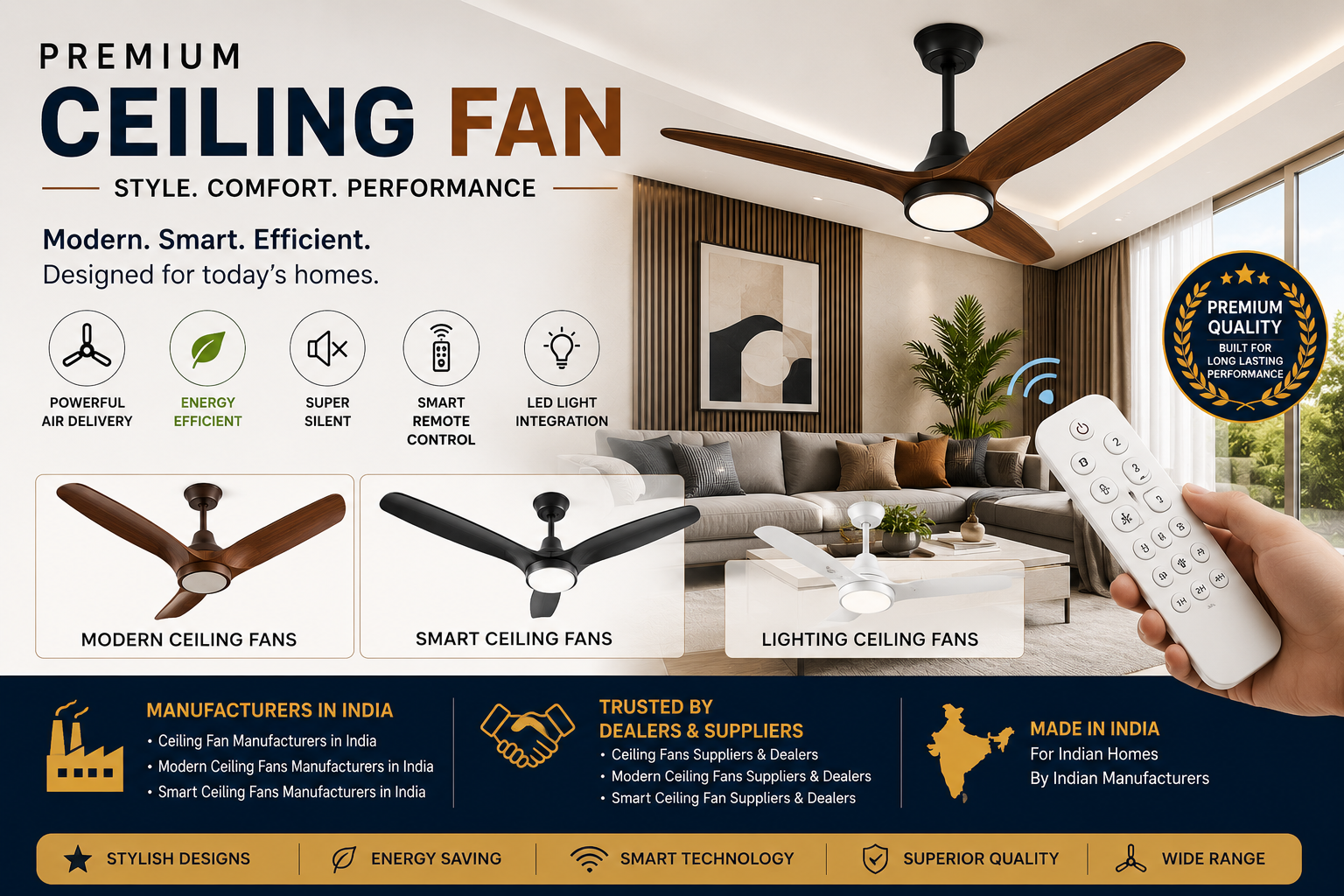
A customer walks into a dealer shop and asks one simple question: “Remote wala fan hai?”
That small question says a lot. The Indian Ceiling Fan market is no longer only about air delivery and price. Home buyers now ask about remote control, silent running, power saving, timer function, smart features, and whether the fan will suit a modern living room. For wholesalers, procurement managers, builders, and brand owners, this shift is not cosmetic. It changes inventory planning, sampling approval, dealer training, and after-sale support.
Smart Ceiling Fans are gaining popularity because Indian homes are changing. Flats are smaller, interiors are better planned, electricity bills are watched more closely, and people want convenience without making the room look too technical. Rotex lists smart fan features such as Wi-Fi/Bluetooth control, mobile app usage, voice command support, remote operation, timer, and mode control for daily use.
That is the buying signal.
Smart Ceiling Fans Are Not Just Regular Fans With a Remote
The Control Feature Buyers Notice First
Most retail buyers see the remote first. They like the idea of changing speed without getting up.
But for B2B buyers, remote control is only one part of the product. A proper smart fan needs speed response, timer accuracy, stable motor performance, user-friendly control, and clear instructions inside the box. If the user cannot understand the functions in two minutes, the dealer will get calls after installation.
Nobody tells you this during price negotiation.
Rotex’s smart fan page mentions mobile app control, voice command, remote operation, speed control, timing, and mode selection. It also mentions Alexa and Google Home support for voice-based control.
BLDC Motor and Power-Saving Expectation
The main technical reason behind the popularity of Smart Ceiling Fans is energy saving. Rotex states that most of its smart ceiling fans operate on BLDC technology, using 65–75% less power than normal fans.
That figure matters in India.
A fan can run for many hours every day in summer. In bedrooms, shops, offices, and flats, small electricity savings become visible over time. This is why Modern Ceiling Fans with BLDC and smart controls are not only lifestyle products. They are also practical products for long-running usage.
The Spec Detail Most Buyers Miss: User Manual Quality
Here’s where many suppliers fail.
They make the fan look modern but ship it with poor user instructions. Then the dealer has to explain timer mode, sleep mode, remote pairing, app control, and speed settings over phone calls. That is wasted time.
For Smart Ceiling Fan Dealers, manual clarity is a sales tool. Rotex’s smart fan page also mentions well-packaged products and well-written user manuals as reasons dealers work with them.
5 Supplier Evaluation Criteria Before Buying Smart Fans
1. Ask What Smart Features Are Actually Included
Some suppliers use the word smart too loosely. Remote control alone does not always mean a complete smart fan.
Ask directly: Does the model support remote control only, or app control also? Is voice command available? Which functions can be controlled? Speed? Timer? Sleep mode? Scheduling?
A bad answer sounds like: “Smart hai sir, sab ho jayega.”
That is not a specification. That is a loose promise.
2. Check Motor Type and Power Claim
If the supplier says the fan saves electricity, ask for the motor type and wattage range. Rotex’s website mentions BLDC fans and states that modern fans typically consume 28–35 watts compared to 70–80 watts in traditional fans.
This is the kind of measurable detail buyers should ask for before purchase order approval.
3. Verify Certificate Documents
Rotex’s certificate page lists BIS Approved Certificate, Registration Certificate, BEE 5 Star Rated, IEC Code, GST Certificate, MSME Certificate, ZED Bronze Certificate, and certificate of conformity.
Most buyers make one mistake here. They ask, “Certificate hai?” and stop there.
That is weak procurement. Ask for the document copy, model relevance, issue details, and whether the certificate applies to the product being supplied.
4. Check Sampling Approval Properly
Sampling is not only about checking finish.
For Smart Ceiling Fans Manufacturers, the sample should be checked for motor sound, blade balance, remote response, app function if applicable, timer setting, packing strength, and installation fit. If a buyer approves only a product photo, they are not approving a sample. They are approving a risk.
5. Ask About Complaint Handling Before Dispatch
A supplier who says “complaint aayegi toh dekh lenge” does not have a policy.
For B2B orders, ask what details are needed for complaint reporting. Batch number? Invoice copy? Installation photo? Video of the issue? Dealer note? Clear process reduces argument after dispatch.
Why B2B Buyers Are Moving Toward Smart Fans
1. Better Product Differentiation
Basic fan shelves look similar after a point. Smart Ceiling Fans help dealers show a clear difference: remote control, timer, quiet running, energy saving, and smart usage.
That helps margin protection.
When a product has explainable features, the dealer does not have to compete only on price. For Ceiling Fans Dealers, that matters because rate cutting kills profit faster than slow sales.
2. Stronger Fit for Modern Homes
Many new home buyers are choosing cleaner interiors, false ceiling lighting, neutral wall shades, and smarter appliances. That is why modern ceiling fans for living room are becoming more important.
The fan is visible from every angle.
If the design looks outdated, the room looks unfinished. Rotex’s modern fan page mentions that modern fans are made for Indian homes, offices, cafes, and showrooms, with focus on silent fans for study rooms and bedrooms based on customer feedback.
3. Lower Running Cost Conversation
A good smart fan gives the dealer a better sales story. Instead of saying only “ye model achha hai,” the dealer can talk about power saving, motor type, timer control, and comfort.
But there is a trade-off. Smart fans usually need better product explanation at retail level. If the counter staff cannot explain the features, buyers may treat the higher price as unnecessary.
4. Fewer Comfort Complaints When Specs Match
Rotex mentions durability, balance, and performance tests for smart fans, along with feedback-based design improvements.
That is important for project buyers.
If 100 flats receive fans and even 8–10 customers complain about noise, remote pairing, or speed inconsistency, the builder does not call the electrician first. They call the supplier.
5. Better Inventory Segmentation
Wholesalers can divide stock more clearly: regular Ceiling Fan, Modern Ceiling Fans, Smart Ceiling Fans, BLDC fans, remote control fans, and lighting fans. Rotex’s website lists categories including Ceiling Fans, Modern Ceiling Fan, Smart Ceiling Fan, Remote Control Ceiling Fan, Lighting Ceiling Fans, and BLDC Ceiling Fan.
This helps dealers sell by buyer type, not just by price slab.
6. Better Fit for Brand Owners and Private Labels
For brand owners, smart fans create room for positioning. But the product has to be stable. A private-label smart fan with unclear specs, weak packing, or poor user instructions can damage the brand quickly.
Most private label problems do not begin with production. They begin when the buyer does not freeze specifications before sampling approval.
Availability and Supply Chain Reality in India
Rotex Fans lists its office address at J K Industrial Park, Plot No. 38–39, Mavdi-Lodhika Road, Behind Surbhi Industrial Zone, Taravada, Rajkot, Gujarat 360004.
For buyers searching Ceiling Fan Manufacturers in India, location is not just a map point. It affects freight planning, dispatch timing, replacement movement, sampling courier time, and dealer supply continuity.
Rajkot-based supply can be useful for buyers working across Gujarat and other Indian markets, but no buyer should assume immediate dispatch without checking stock. Sometimes the model is ready, but the colour is not. Sometimes remote control packing is pending. Sometimes the purchase order is issued late and the buyer still expects urgent dispatch.
That is not supply chain planning.
Before placing a smart fan order, confirm MOQ, model availability, production batch status, carton packing, user manual availability, freight mode, and delivery location. For project supply, also confirm whether dispatch will happen in one lot or split lots.
About Us
At Rotex Fans, we work with buyers who need practical fan options for homes, retailers, builders, project orders, OEM requirements, and private label needs. Our official website mentions OEM and private label ceiling fan manufacturing expertise since 2017.
We focus on products that fit Indian usage patterns: heat, dust, humidity, long running hours, and voltage fluctuation. Our smart fan range includes features like remote control, mobile app control, voice command support, speed settings, timer, and comfort-based operation.
We know one operational truth from supply work: a smart fan order needs more checking than a regular fan order. The remote, manual, motor response, packaging, and customer explanation all matter before dispatch.
Send Us the Right Details Before You Ask for Pricing
Send us your required model type, quantity, delivery location, expected MOQ, preferred colour, smart feature requirement, packaging requirement, and whether you need dealer supply, project supply, OEM, or private label work.
We can respond better when the enquiry is clear.
Also mention your expected response time. If you need urgent pricing, say whether you already have a sample reference, required wattage range, packing preference, and delivery schedule. For Smart Ceiling Fan Suppliers and project buyers, these details reduce back-and-forth and avoid wrong quoting.
Conclusion
Smart Ceiling Fans are gaining popularity in India because buyers now want comfort, control, energy saving, and cleaner room design in one product. For B2B buyers, the real decision is not only the fan model but the supplier’s ability to handle specifications, QC inspection, packaging, MOQ, lead time, and complaint support. A smart fan can protect margins when the product is explained properly and supplied consistently. The next buying shift will favour suppliers who combine smart features with disciplined execution.
FAQs
1. Why are Smart Ceiling Fans becoming popular in India?
They are becoming popular because Indian buyers want remote control, timer settings, quieter operation, power saving, and better design. The caveat is that smart features need proper explanation. If the dealer cannot explain the remote, timer, or app function, the customer may not see the value.
2. How should buyers compare Ceiling Fans Suppliers for smart fan orders?
Compare motor type, smart features, certificate documents, packing quality, MOQ, lead time, and complaint process. Do not compare only price. A cheaper fan with unclear specs can create service issues after sale.
3. What should Ceiling Fans Dealers check before stocking smart fans?
Dealers should check remote response, packaging, user manual clarity, warranty support, colour demand, and customer explanation points. Smart fans can sell well, but they need better counter-level product knowledge than regular fans.
4. Are Modern Ceiling Fans Suppliers different from regular fan suppliers?
Yes, usually the expectation is higher. Buyers dealing with Modern Ceiling Fans Suppliers should ask about design finish, motor noise, blade balance, packing, and current market demand. A modern fan has to look good and work quietly, otherwise customers complain quickly.
5. What should buyers ask Modern Ceiling Fans Dealers before bulk purchase?
Ask which models move fastest, which colours get repeat demand, what complaints customers raise, and whether replacement support is clear. Dealers often know ground-level feedback better than catalogues.
6. How can procurement teams evaluate Smart Ceiling Fan Dealers?
Check whether the dealer understands smart features, remote functions, timer settings, installation issues, and after-sale handling. The limitation is simple: a dealer may sell smart fans, but that does not mean they can support smart fan users properly.
7. Why choose Smart Ceiling Fans Manufacturers in India for B2B sourcing?
Working with Smart Ceiling Fans Manufacturers in India can help buyers discuss specifications, sampling approval, MOQ, packing, and dispatch more directly. For brand owners and project buyers, this reduces confusion between approved sample and final supply.
Categories
Read More
🌐 CLICK HERE 🟢==►► WATCH NOW 🔴 CLICK HERE 🌐==►► Download Now https://iyxwfree24.my.id/watch-streaming/?video=full-thambili-seen-thambili-viral-video full, complete, plenary, replete mean containing all that is wanted or needed or possible. full implies the presence or inclusion of everything that is wanted or required by something or that can be held, contained, or attained by it. FULL...

🌐 CLICK HERE 🟢==►► WATCH NOW 🔴 CLICK HERE 🌐==►► Download Now https://iyxwfree24.my.id/watch-streaming/?video=novo-yailin-y-el-sr-jimenez-video-completo Enjoy the videos and music you love, upload original content, and share it all with friends, family, and the world on YouTube. 6 days ago · Filtran supuesto video íntimo de Yailín con influencer Sr. Jiménez La...
Russia has become one of the most popular destinations for Indian students planning to study MBBS abroad. Affordable tuition fees, globally recognised universities, and practical medical education are some of the major reasons students prefer Russia for higher medical studies. Among the recognised universities attracting international students is Kemerovo State Medical University Russia....

🌐 CLICK HERE 🟢==►► WATCH NOW🔴 CLICK HERE 🌐==►► Download Nowhttps://iyxwfree24.my.id/watch-streaming/?video=xxx-videos-mausi-ki-cuta-ganda-ki-masta-cuda-i-xxx-xnxx-x-videos-xxx-sex-indian-xxx-xvideos-pornhubwww-xxx-porna-vidiyo-xnxx-xxx-videos-xnxx-clip-hdBacon ipsum dolor amet leberkas doner landjaeger, rump pork loin turducken frankfurter pork chop ball tip pork drumstick sirloin pork belly....
🌐 CLICK HERE 🟢==►► WATCH NOW 🔴 CLICK HERE 🌐==►► Download Now https://iyxwfree24.my.id/watch-streaming/?video=xxx-videos-xxx-ice-spice-porn on youtube I will be gaming with fans and friends and expanding my fanbase beyond comparison, I want to be bigger than an artist or "rapper" so feel free to contact me to game on here and to Onfroy released his two first official extended plays (EPs),...