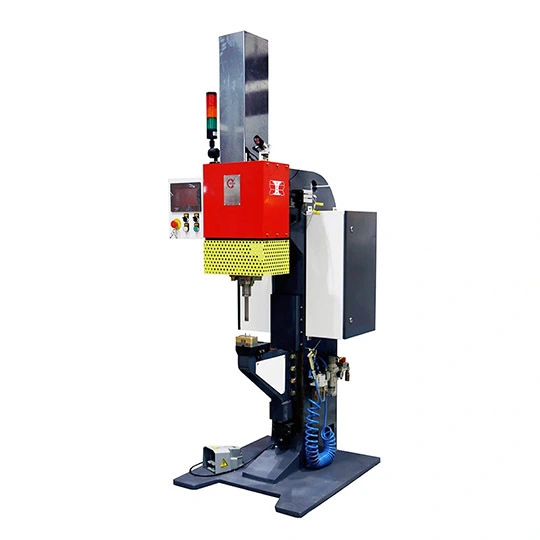
In today’s manufacturing landscape, the shift toward lightweight, multi-material structures has made traditional joining methods increasingly limited. Processes like welding and bolting often struggle with aluminum alloys, composites, and mixed-material assemblies.
This is where self-pierce riveting (SPR) becomes a game-changing solution. It is a cold mechanical joining technology that allows two or more sheets of material to be fastened without pre-drilled holes, heat, or surface damage, making it highly suitable for automotive, aerospace, rail, and industrial applications.
For OEMs and automation engineers, SPR is not just an alternative it is a strategic enabling technology for next-generation lightweight manufacturing.
What is Self-Pierce Riveting?
Self-pierce riveting is a mechanical fastening process where a specially designed semi-tubular rivet is forced through the top layer(s) of material but does not fully penetrate the bottom sheet.
Instead, the rivet flares outward under controlled pressure from a die, creating a mechanical interlock between layers without breaking through the bottom surface.
Key Characteristics:
- No pre-drilling required
- No heat or welding involved
- Works on dissimilar materials
- Creates strong mechanical interlock
- Suitable for automation and high-speed production
This makes SPR especially valuable in automotive body-in-white (BIW) assembly lines and multi-material structures.
How the Self-Pierce Riveting Process Works
The SPR process is simple in principle but highly engineered in execution:
1. Clamping Stage
The sheets are firmly held between a die and blank holder to ensure alignment and stability.
2. Rivet Insertion
A high-force punch drives the rivet through the top layer(s) of material.
3. Controlled Piercing
The rivet pierces only the upper layers and begins deforming as it reaches the bottom sheet.
4. Die Forming & Flare Out
The die forces the rivet legs to expand outward, forming a mechanical lock within the bottom sheet.
5. Final Joint Formation
A strong, fatigue-resistant joint is formed without compromising the surface integrity.
This cold-forming process ensures no heat-affected zone (HAZ), which is a major advantage over welding in sensitive materials.
Engineering Advantages of Self-Pierce Riveting
For manufacturing engineers and production managers, SPR offers a combination of performance, flexibility, and efficiency.
1. Strong Multi-Material Joining
SPR can join:
- Aluminum-to-steel
- Aluminum-to-aluminum
- Composite-to-metal combinations
This capability is critical in EV and lightweight vehicle production.
2. No Heat-Affected Zone
Unlike welding, SPR avoids thermal distortion, preserving:
- Material strength
- Surface coating integrity
- Corrosion resistance
3. High Fatigue Strength
SPR joints perform exceptionally well under:
- Vibrations
- Cyclic loading
- Automotive dynamic stress conditions
4. Automation Ready
SPR is widely used in robotic production lines, making it ideal for:
- High-volume automotive assembly
- Smart factory integration
- Industry 4.0 manufacturing systems
5. Clean & Efficient Process
- No fumes or sparks
- No filler materials
- Minimal post-processing required
Self-Pierce Riveting vs Traditional Joining Methods
SPR vs Spot Welding
Spot welding is widely used but has limitations with aluminum and coated materials. SPR offers:
- Better performance in dissimilar materials
- No thermal weakening
- Stronger fatigue resistance
SPR vs Mechanical Bolting
Bolting is flexible but:
- Requires access from both sides
- Adds weight
- Needs regular maintenance
SPR provides:
- Permanent joining
- Lighter assemblies
- Faster cycle times
SPR vs Adhesive Bonding
Adhesives offer sealing but lack:
- Immediate structural strength
- High-temperature resistance
SPR complements adhesives in hybrid joining systems.
Industrial Applications of Self-Pierce Riveting
SPR is widely adopted across advanced manufacturing sectors:
Automotive Industry
- Body-in-white structures
- Door panels and roof assemblies
- EV lightweight chassis
Aerospace Components
- Lightweight fuselage panels
- Interior structural assemblies
Rail & Transportation
- High-speed train body structures
- Vibration-resistant joints
Appliance & Industrial Equipment
- HVAC housings
- Metal enclosures
- Multi-layer structural frames
The growing demand for lightweight engineering and fuel efficiency is accelerating SPR adoption globally.
Best Practices for High-Quality SPR Joints
To ensure consistent performance in production environments, engineers should consider:
1. Material Compatibility
- Ensure ductility of upper sheet
- Maintain proper hardness balance between layers
2. Rivet and Die Selection
- Match rivet geometry to material thickness
- Use correct die cavity for proper flaring
3. Process Parameter Control
- Punch force optimization
- Clamping pressure stability
- Accurate rivet positioning
4. Quality Inspection Methods
- Cross-sectional analysis
- Non-destructive testing (NDT)
- Automated vision systems for defect detection
5. Simulation & Process Validation
Modern manufacturers increasingly use digital simulation to reduce trial-and-error and improve joint reliability before production.
Role of HERON WELDER in Self-Pierce Riveting Solutions
As a global manufacturer of advanced resistance welding and metal-joining systems, Heron Welder supports industries transitioning toward hybrid and automated joining technologies.
Heron’s expertise in:
- Automated welding production lines
- High-precision joining systems
- Industrial controllers and integration
- Custom engineering solutions
positions it as a strong partner for manufacturers implementing SPR-based production environments.
From concept design to full-scale automation, Heron delivers engineering-driven joining solutions tailored for modern factories.
FAQs: Self-Pierce Riveting
1. What materials can be joined using self-pierce riveting?
SPR can join aluminum, steel, magnesium alloys, and composite materials, including multi-layer combinations.
2. Is self-pierce riveting stronger than welding?
In many mixed-material and aluminum applications, SPR offers better fatigue resistance and avoids heat-related weakening compared to welding.
3. Does SPR require pre-drilling?
No. One of the key advantages of SPR is that it eliminates the need for pre-drilled holes.
4. Can SPR be automated in production lines?
Yes, SPR is widely used in robotic assembly lines for high-speed and high-volume manufacturing.
5. What industries use self-pierce riveting the most?
Automotive, aerospace, rail transportation, and industrial equipment manufacturing are the primary adopters.
Conclusion
Self-pierce riveting represents a modern evolution in mechanical joining technology, enabling manufacturers to build lighter, stronger, and more efficient structures without the limitations of heat-based processes.
For OEMs and engineering teams focused on automation, productivity, and material innovation, SPR provides a reliable and scalable solution aligned with next-generation manufacturing demands.
Partner with HERON WELDER for Advanced Joining Solutions
If you are looking to integrate self-pierce riveting, resistance welding, or automated joining systems into your production line, HERON WELDER provides customized engineering support and industrial-grade solutions designed for performance and scalability.
Contact HERON WELDER today to request a quote or discuss a tailored solution for your manufacturing needs.