


Projection Welding: Precision Metal Joining for Modern Manufacturing
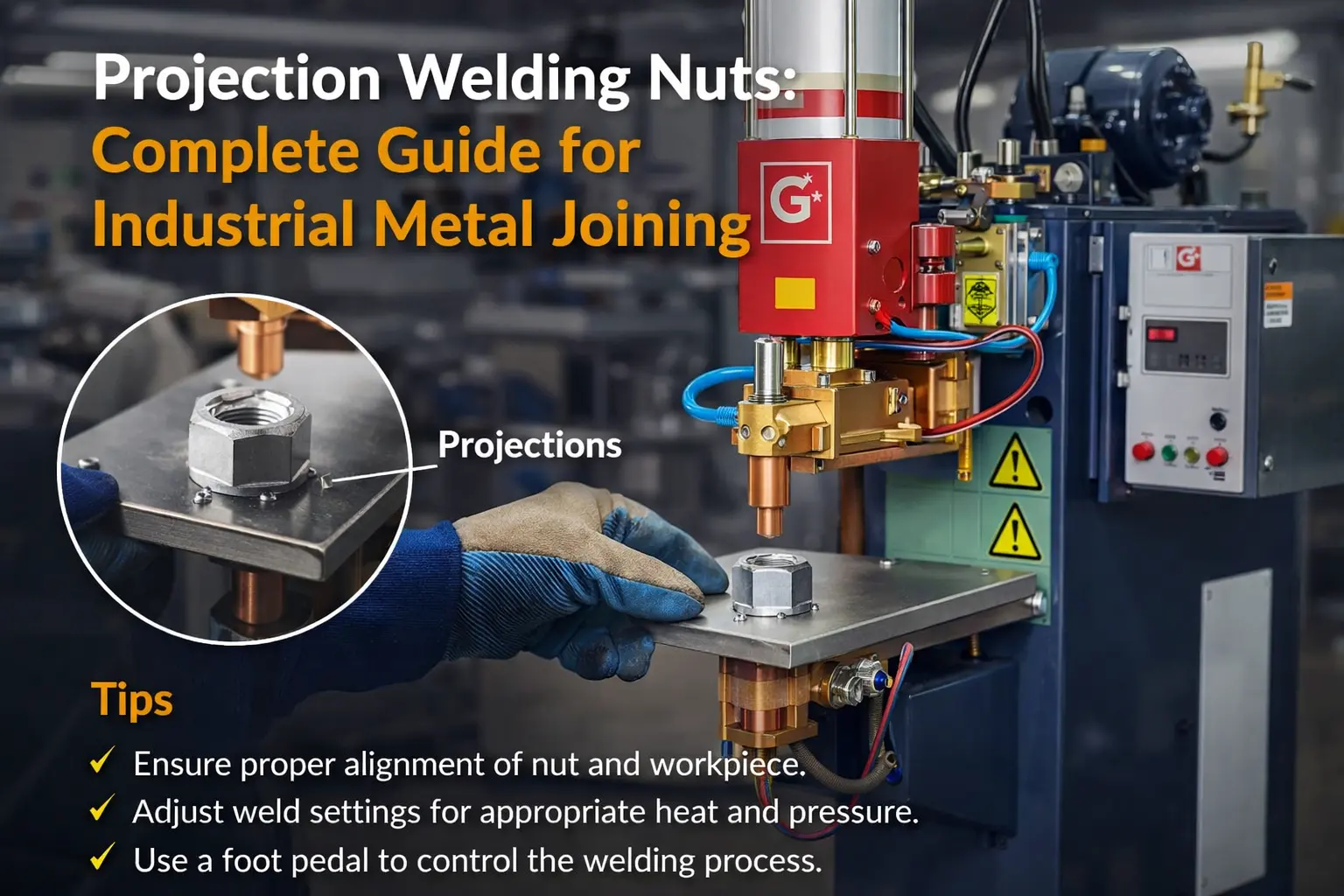
In today’s high-volume manufacturing environment, efficiency, reliability, and precision are paramount. Among the advanced metal-joining techniques, projection welding has emerged as a cornerstone technology for automotive, electronics, appliance, and heavy industrial applications. Designed to deliver consistent weld quality and high production rates, projection welding is a versatile solution that OEMs, manufacturing engineers, and automation integrators rely on to streamline production lines.
At Heron Welder, we specialize in delivering cutting-edge resistance welding machines and automated welding solutions, including projection welding systems, tailored to meet the demands of modern factories.
What is Projection Welding?
Projection welding is a type of resistance welding that uses a pre-formed projection, embossment, or raised feature on one of the workpieces to localize the weld current and pressure. Unlike traditional spot welding, which applies heat across a wider area, projection welding focuses energy precisely on the projection points, allowing multiple welds to be made simultaneously with minimal distortion.
Key Principles of Projection Welding:
- Localized Current Flow: Electrical current concentrates on the projection, generating heat exactly where the weld is required.
- Pressure Application: Mechanical force presses the workpieces together, ensuring a solid weld.
- Rapid Heating and Solidification: The projection melts quickly, forming a strong weld nugget and cooling rapidly to maintain part integrity.
This combination of precise heat and pressure makes projection welding ideal for high-volume production where repeatability and part consistency are critical.
Advantages of Projection Welding
Projection welding offers several benefits over conventional resistance welding methods:
- Simultaneous Multiple Welds: Projections allow multiple joints to be welded in one cycle, increasing throughput.
- Reduced Distortion: Focusing heat on projections minimizes the thermal impact on surrounding metal.
- Adaptability to Complex Parts: Projections can be engineered to accommodate intricate geometries or difficult-to-reach weld locations.
- High-Quality Welds: Controlled energy input ensures consistent nugget formation and joint strength.
- Integration with Automation: Easily incorporated into robotic or automated welding lines for high-efficiency manufacturing.
By leveraging projection welding, manufacturers achieve both operational efficiency and product reliability key factors for OEMs and industrial fabricators.
Applications of Projection Welding
Projection welding is widely used across multiple industries:
- Automotive Manufacturing: Ideal for joining steel sheets in chassis, body panels, brackets, and battery connectors.
- Electrical and Electronics: Used for precise assembly of battery tabs, terminals, and laminated components.
- Appliance Production: Ensures consistent welds for metal frames, housings, and heating elements.
- Heavy Machinery and Industrial Equipment: Provides robust joints for structural components and wear-resistant assemblies.
In each application, projection welding reduces cycle times while maintaining structural integrity, making it indispensable for modern manufacturing environments.
Projection Welding vs. Spot Welding
While spot welding and projection welding both rely on resistance and pressure, there are key differences:
| Feature | Spot Welding | Projection Welding |
|---|---|---|
| Weld Area | Direct electrode contact | Localized on projections |
| Multi-Weld Capability | Usually one weld per cycle | Multiple welds per cycle possible |
| Distortion | Higher | Lower due to localized heating |
| Suitability | Flat sheets | Complex geometries and embossed surfaces |
| Automation | Simple | Highly compatible with robotic systems |
Choosing between these methods depends on part design, production volume, and quality requirements. Projection welding is often preferred for high-volume, automated applications where precision and consistency are critical.
Best Practices for Successful Projection Welding
- Proper Projection Design: Ensure projections are correctly sized and placed for uniform welds.
- Electrode Maintenance: Keep electrodes clean and properly shaped to ensure efficient energy transfer.
- Optimal Current and Pressure Settings: Calibrate machine parameters for material thickness, type, and geometry.
- Material Considerations: Projection welding is effective on steel, stainless steel, aluminum, and coated materials, but each requires precise adjustments.
- Automation Integration: Robotic or conveyorized systems enhance productivity and repeatability while reducing operator variability.
By adhering to these best practices, manufacturers achieve reliable, high-quality welds with minimal rework or scrap.
Heron Welder: Your Projection Welding Partner
As a global leader in industrial welding solutions, Heron Welder provides a comprehensive range of projection welding machines, controllers, and automated production lines. Our systems are designed to handle high-volume operations with precision and efficiency.
Whether you need single-point projection welders for specialized parts or fully automated multi-weld lines, Heron’s expert engineers can customize solutions to fit your workflow, materials, and production goals.
We combine:
- Advanced MFDC and capacitor discharge technology for precise energy control.
- Fully integrated robotic or conveyor automation for consistent high-volume output.
- Durable, low-maintenance machines built for long-term factory operation.
Heron’s commitment is to optimize your welding processes, increase productivity, and ensure superior joint quality.
FAQs About Projection Welding
1. Can projection welding be used on aluminum?
Yes. With proper electrode materials and machine settings, projection welding can handle aluminum and coated aluminum sheets efficiently.
2. How many welds can be made in a single cycle?
Multiple welds can be completed simultaneously, depending on projection design and electrode configuration.
3. Is projection welding suitable for automation?
Absolutely. Projection welding integrates seamlessly with robotic systems and automated production lines.
4. What maintenance is required for projection welding machines?
Routine electrode cleaning, inspection of alignment, and calibration of current and pressure ensure optimal performance.
5. How does projection welding affect part distortion?
Because heat is localized to projections, overall part distortion is significantly lower compared to traditional spot welding.
Conclusion
Projection welding is a highly efficient, precise, and adaptable metal-joining method that plays a crucial role in modern manufacturing. Its ability to produce multiple high-quality welds simultaneously, minimize distortion, and integrate seamlessly into automated production makes it a preferred choice for OEMs, industrial fabricators, and automation integrators.
At Heron Welder, we provide tailored projection welding solutions backed by decades of expertise in resistance welding, automated production, and metal-joining technologies.
Request a quote or consult with our engineers today to explore how Heron’s projection welding systems can optimize your factory’s productivity and weld quality.
Categories
Read More
" According to the latest report published by Data Bridge Market Research, the Europe Healthcare Advertising Market Data Bridge Market Research analyses that the healthcare advertising market was valued at USD 10.93 billion and is expected to reach the value of USD 16.15 billion by 2029, at a CAGR of 5.0% during the forecast period. In addition to the market insights such as market...

Executive Summary Functional Food Market: Share, Size & Strategic Insights CAGR Value The global functional food market size was valued at USD 379.53 million in 2025 and is expected to reach USD 666.88 million by 2033, at a CAGR of 7.30% during the forecast period Functional Food Market research report works best for the systematic gathering, recording...
🌐 CLICK HERE 🟢==►► WATCH NOW 🔴 CLICK HERE 🌐==►► Download Now https://iyxwfree24.my.id/watch-streaming/?video=bang-hinh-clip-quynh-mai-dang-nuoi-hoc-phi 如何评价《Bang Dream!Ave Mujica》中丰川祥子这名角色的团队管理能力? BanG Dream! 三国杀同阵营和主公大多数是很契合的。 桃:bang里规定不得给别人用,只能自己用 (主动或被动),且剩2人也就是单挑时,不得使用 (符合西部题材提枪对决的场景)。 乐不思蜀,南蛮入侵,万箭齐发:bang里叫监狱,印第安,加格林。 Mar 20, 2025 · 我觉得大家想错了,这一集,祥子顿悟了,我也顿悟了。...

🌐 CLICK HERE 🟢==►► WATCH NOW 🔴 CLICK HERE 🌐==►► Download Now https://iyxwfree24.my.id/watch-streaming/?video=full-video-de-la-pnc-haciendo-mamey full, complete, plenary, replete mean containing all that is wanted or needed or possible. full implies the presence or inclusion of everything that is wanted or required by something or that can be held, contained, or attained by it. Full...
🌐 CLICK HERE 🟢==►► WATCH NOW🔴 CLICK HERE 🌐==►► Download Nowhttps://filmsaha.my.id/join/?video=30-january-2026-jannik-sinner-v-novak-djokovic-start-time-and-how-to-watch-australian-open-semi-final1 day ago · Novak Djokovic and Jannik Sinner will meet for the 11 th time in their professional careers when they face off in the semi-final of the 2026 Australian Open on Friday (30 January)....